
Solar Rooftop EPC
Owning rooftop space and utilizing it for solar installations offers significant financial savings along with long-term sustainability benefits for both residential and personal use.
In many cases, rooftops provide sufficient area to generate power equal to—or even exceeding—the actual energy requirement. Backed by extensive installation experience, Modifiye Green Solar has the expertise and capacity to execute multiple rooftop solar EPC projects simultaneously with efficiency and precision.

Solar Rooftop EPC
Owning rooftop space and utilizing it for solar installations offers significant financial savings along with long-term sustainability benefits for both residential and personal use.
In many cases, rooftops provide sufficient area to generate power equal to—or even exceeding—the actual energy requirement. Backed by extensive installation experience, Modifiye Green Solar has the expertise and capacity to execute multiple rooftop solar EPC projects simultaneously with efficiency and precision.
What is an On‑Grid Solar System?
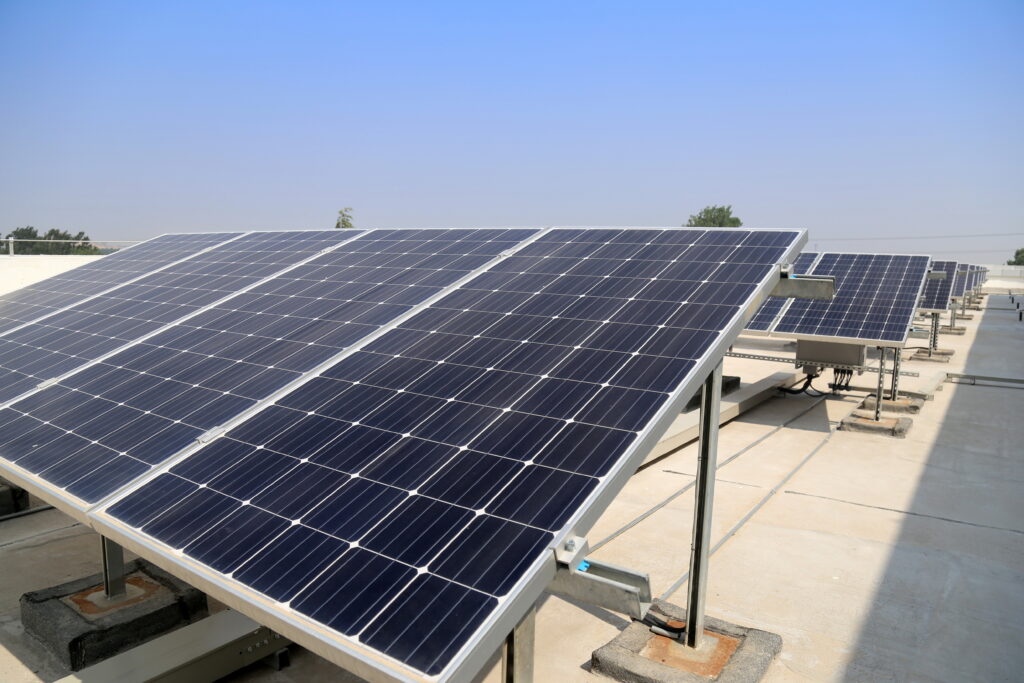
An on‑grid (grid‑tied) solar system is a PV system connected directly to the public grid; it supplies your loads first and then sends extra power to the grid. When solar is not enough (night, cloudy), the same connection draws power back from the grid automatically.
How On‑Grid System Works
Solar panels generate DC power from sunlight and send it to a grid‑tied inverter.
The inverter converts DC to AC in sync with grid voltage and frequency and feeds your home/office loads through the main distribution board.
If generation > consumption, surplus energy flows through the bidirectional (net) meter into the grid and earns bill credits.
If consumption > generation, deficit power is imported from the grid and you pay only for net import as per your state policy.
Key Components
Solar PV modules mounted on roof or ground.
Grid‑tie inverter (no battery), designed to shut down automatically if grid goes off (anti‑islanding safety).
AC and DC protection devices (MCB/MCCB, SPD, isolators, earthing, lightning arrestor).
Net meter / bidirectional meter to record import and export of energy.
Off‑Grid Solar System (Completely Independent)

An off‑grid solar system works without any support from the electricity grid. It is fully dependent on solar panels + batteries + inverter for power.
Main Characteristics
No grid connection: The system is not connected to the utility grid at all; even if grid is present, the off‑grid inverter runs independently.
Mandatory battery bank: Because there is no grid support, all extra solar energy must be stored in batteries to be used at night or during cloudy periods.
Use cases: Remote villages, farm houses, forest resorts, telecom towers, sites with no grid or extremely unreliable grid where long power cuts are common.
Core Components
Solar PV modules: Generate DC power from sunlight.
Charge controller / inverter:
Either a separate MPPT/charge controller + inverter, or
A combined off‑grid solar inverter that handles charging and AC output.
Battery bank: Sized based on backup hours and load; this is the most critical and also costliest part after panels.
Mounting structure: Roof‑top or ground‑mount frames to hold panels at correct tilt.
Protection system: DC/AC MCBs, surge protection devices, fuses, earthing and lightning protection.
Working Logic
Daytime:
Solar panels generate DC power.
Power first runs the connected loads (fans, lights, pumps, etc.).
Extra power charges the battery bank through the charge controller/inverter.
Night / cloudy weather:
When solar generation is low or zero, loads run purely on stored energy from batteries.
If battery gets discharged beyond a safe limit, the inverter cuts off to protect the batteries, and power is not available until sunlight recharges them.
Pros and Cons
Advantages:
Complete independence from grid.
Ideal where grid is not available at all.
Disadvantages:
High initial cost due to batteries.
Batteries need periodic replacement, so long‑term maintenance cost is higher.
System must be sized very carefully; if battery or panel sizing is wrong, user will face frequent power shortages.
Hybrid / “High‑Grid” Solar System
Hybrid solar system combines solar, batteries and the utility grid in one integrated setup. Many people informally call this “high‑grid” because it gives both high reliability and grid connectivity.
Main Characteristics
Three power sources: Solar panels, battery bank and grid (and sometimes DG).
Smart inverter: A hybrid inverter manages charging, discharging, solar usage, and grid interaction automatically.
Flexible operation:
Can power loads directly from solar.
Can store surplus solar in batteries.
Can import power from grid when solar and battery are not enough.
In some models, can export surplus power to grid (net‑metering), depending on local rules.
Components
Solar panels: Similar to off‑grid/on‑grid, sized as per energy requirement.
Hybrid inverter:
Has inputs for solar DC, battery, and grid.
Can work in multiple modes (solar priority, battery priority, grid priority, time‑of‑use, etc.).
Battery bank (optional but recommended): Allows backup power during grid failure and better use of solar energy.
Grid connection: Connected to main distribution panel and meter; if allowed, net meter can record export and import.
Protection and earthing: As in off‑grid, with additional grid‑side protections and compliance with utility requirements.
Working Logic
Typical priority logic (configurable):
Daytime with good sun:
Solar runs the load directly.
Extra power charges batteries.
If batteries are full and system supports export, extra may go to grid.
Evening / low sun, grid available:
System may use battery plus grid as per setting.
For example, first battery down to a set SOC, then grid.
Grid failure:
System automatically switches to “island mode” and runs loads from solar + battery.
Critical loads can be put on a separate backed‑up line so that not everything trips.
Pros and Cons
Advantages:
Backup during power cuts (unlike simple on‑grid).
Can still reduce electricity bill significantly using solar.
More flexible: suitable for urban/semi‑urban areas with grid but frequent cuts.
Disadvantages:
Cost higher than pure on‑grid due to batteries and more advanced inverter.
Design and configuration are more complex, so skilled EPC execution is important.
Off‑Grid vs Hybrid vs Simple On‑Grid
Below is a quick comparison that you can also use to explain to clients.
| Point | Off‑Grid Solar | Hybrid (High‑Grid) Solar | Simple On‑Grid Solar |
|---|---|---|---|
| Grid connection | Not connected to grid | Connected to grid + battery | Connected only to grid |
| Battery requirement | Always required | Optional but usually present | Generally not used |
| Power during grid failure | Yes (till battery has charge) | Yes (solar + battery for backup) | No, shuts down when grid is off |
| Ideal use case | Remote / no grid, very poor supply | Cities/towns with grid + frequent power cuts | Areas with stable grid, want bill cut |
| Initial cost per kW | Highest (due to battery size) | Medium to high (depends on battery size) | Lowest |
| Running / replacement cost | Higher (battery replacement) | Medium (depends how hard batteries are used) | Low (no batteries) |
| Design / control complexity | Medium | Highest (many modes, multi‑source control) | Lowest |
| Main customer selling point | Full independence from grid | Backup + bill saving + flexibility | Maximum bill saving at minimum cost |
How EPC Links With These System Types
If you plan to work as an EPC provider:
You should be able to analyse client need and grid condition, then decide whether off‑grid, hybrid or on‑grid is best.
Your engineering scope will change:
Off‑grid: heavy focus on battery and autonomy (how many backup hours).
Hybrid: focus on both bill reduction and backup; smart load segregation (critical vs non‑critical).
On‑grid: focus on maximum generation vs sanctioned load and DISCOM policies.
You can create different EPC packages:
Off‑grid EPC package (for farm houses, remote sites).
Hybrid EPC package (for homes/shops/offices needing backup + savings).
On‑grid EPC package (for rooftops where backup already exists via DG or inverter).
What is an On‑Grid Solar System?
An on‑grid (grid‑tied) solar system is a PV system connected directly to the public grid; it supplies your loads first and then sends extra power to the grid. When solar is not enough (night, cloudy), the same connection draws power back from the grid automatically.
How On‑Grid System Works
Solar panels generate DC power from sunlight and send it to a grid‑tied inverter.
The inverter converts DC to AC in sync with grid voltage and frequency and feeds your home/office loads through the main distribution board.
If generation > consumption, surplus energy flows through the bidirectional (net) meter into the grid and earns bill credits.
If consumption > generation, deficit power is imported from the grid and you pay only for net import as per your state policy.
Key Components
Solar PV modules mounted on roof or ground.
Grid‑tie inverter (no battery), designed to shut down automatically if grid goes off (anti‑islanding safety).
AC and DC protection devices (MCB/MCCB, SPD, isolators, earthing, lightning arrestor).
Net meter / bidirectional meter to record import and export of energy.
Net Metering Basics (India context)
Net metering allows you to send extra solar units to the grid and get one‑to‑one credit on your bill up to policy limits. In India, rooftop systems up to 500 kW or sanctioned load (whichever is lower) are generally allowed for net metering, subject to state regulations. At billing time, DISCOM charges you only on net consumption = units imported − units exported.
Advantages and Limitations
Advantages: Lowest cost per kW (no batteries), high efficiency, very low maintenance, maximum bill saving where grid is reliable and net metering is allowed.
Limitations: No backup during power cuts because inverter must shut down when grid fails; completely dependent on grid presence for operation.